
Built-in Resource Capabilities
MBD2 21.1.1These five capabilities require no optional mod. They are also the reference model for understanding external integrations.
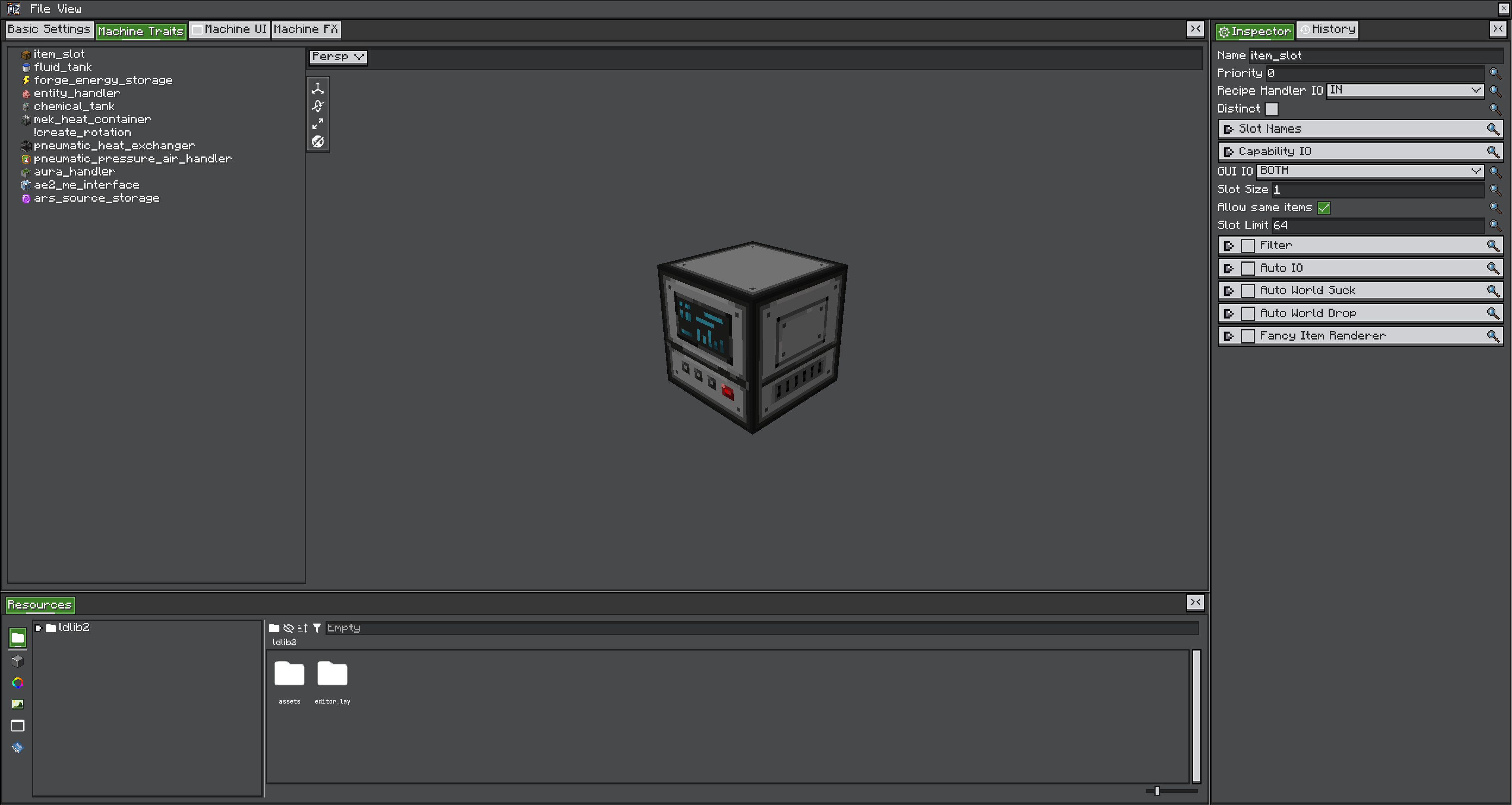
Exact mapping
| Recipe capability | Machine Trait | KubeJS methods | Runtime meaning |
|---|---|---|---|
item | item_slot | inputItems, outputItems | Consume/insert item stacks |
item_durability | item_slot | inputItemsDurability, outputItemsDurability | Damage/repair an existing damageable item |
fluid | fluid_tank | inputFluids, outputFluids | Drain/fill NeoForge fluids |
forge_energy | forge_energy_storage | inputFE, outputFE | Extract/receive integer FE |
entity | entity_handler | inputEntities, outputEntities | Match/remove or spawn entities in a configured AABB |
IO.IN always means the recipe takes something from the machine-side handler; IO.OUT gives something to it. For item_durability, that means input adds damage and output removes damage.
Item and durability
Add item_slot. Configure slotSize, slotLimit, whether equal items may occupy multiple slots, item/tag filtering, and the three independent directions of access:
- Recipe IO decides whether recipes may consume from or produce into this Trait.
- GUI IO decides whether players may place/take stacks in its bound widgets.
- Capability IO / auto IO decides what adjacent automation can see and whether the machine actively pulls/pushes.
The Trait exposes NeoForge Capabilities.ItemHandler.BLOCK. Generated widget IDs are <trait-ui-id>_0, _1, and so on. If two item Traits exist, assign names and route recipe content with slotName; otherwise any compatible handler may satisfy it.
Durability content does not consume the tool stack. The item must already be present, match the ingredient, and be damageable. Requesting 10 durability as input raises its damage value by up to 10; requesting 10 as output repairs up to 10 existing damage.
Fluid
Add fluid_tank. tankSize creates independent tanks and capacity applies to each tank. Configure same-fluid behavior, fluid/tag filters, recipe/GUI/capability IO, active world IO speed/range, and optional in-world fluid rendering.
The Trait exposes Capabilities.FluidHandler.BLOCK. Fluid amounts are in the units accepted by SizedFluidIngredient; use explicit amounts in scripts.
Forge Energy
Add forge_energy_storage. capacity is stored energy; maxReceive and maxExtract limit external transfers. They are not the recipe's per-tick cost. Set recipe content as per-tick when power should be drawn every working tick.
The Trait exposes Capabilities.EnergyStorage.BLOCK. Recipe IN extracts from storage and recipe OUT receives into it. A full output buffer can therefore block recipe completion.
Entity
Add entity_handler and configure its AABB relative to the machine, transformed by front facing. Input handlers rescan alive entities every 20 server ticks. Input content matches entities in that cached area and removes matched entities during real execution; output content creates entities and places them in the area.
Entity handlers expose no ordinary item/fluid-style storage capability. Plan for the one-second scan cadence and protect spawn areas from obstruction or unintended mobs.
Complete KubeJS example
ServerEvents.recipes(event => {
  event.recipes.example.assembler()
    .id('example:charged_cutting')
    .duration(100)
    .inputItems('2x minecraft:iron_ingot')
    .inputItemsDurability('1x minecraft:diamond_pickaxe')
    .inputFluids('250x minecraft:water')
    .perTick(r => r.inputFE(40))
    .outputItems('minecraft:iron_block')
})
The machine definition must contain compatible item_slot, fluid_tank, and forge_energy_storage Traits. This builder does not add them.
Acceptance test
Test each handler with recipe simulation first, then real execution. Verify insufficient input refuses to start, full output waits instead of deleting output, per-tick shortage pauses/stops according to RecipeLogic, side configuration matches external automation, and contents survive a world restart.