
Java Extensions
MBD2 21.1.1Use Java when a pack needs a new storage model, recipe content type, condition, machine subclass, or external-mod capability. MBD2 separates the editor-facing definition from the runtime object, and separates recipe content from the trait that handles it.
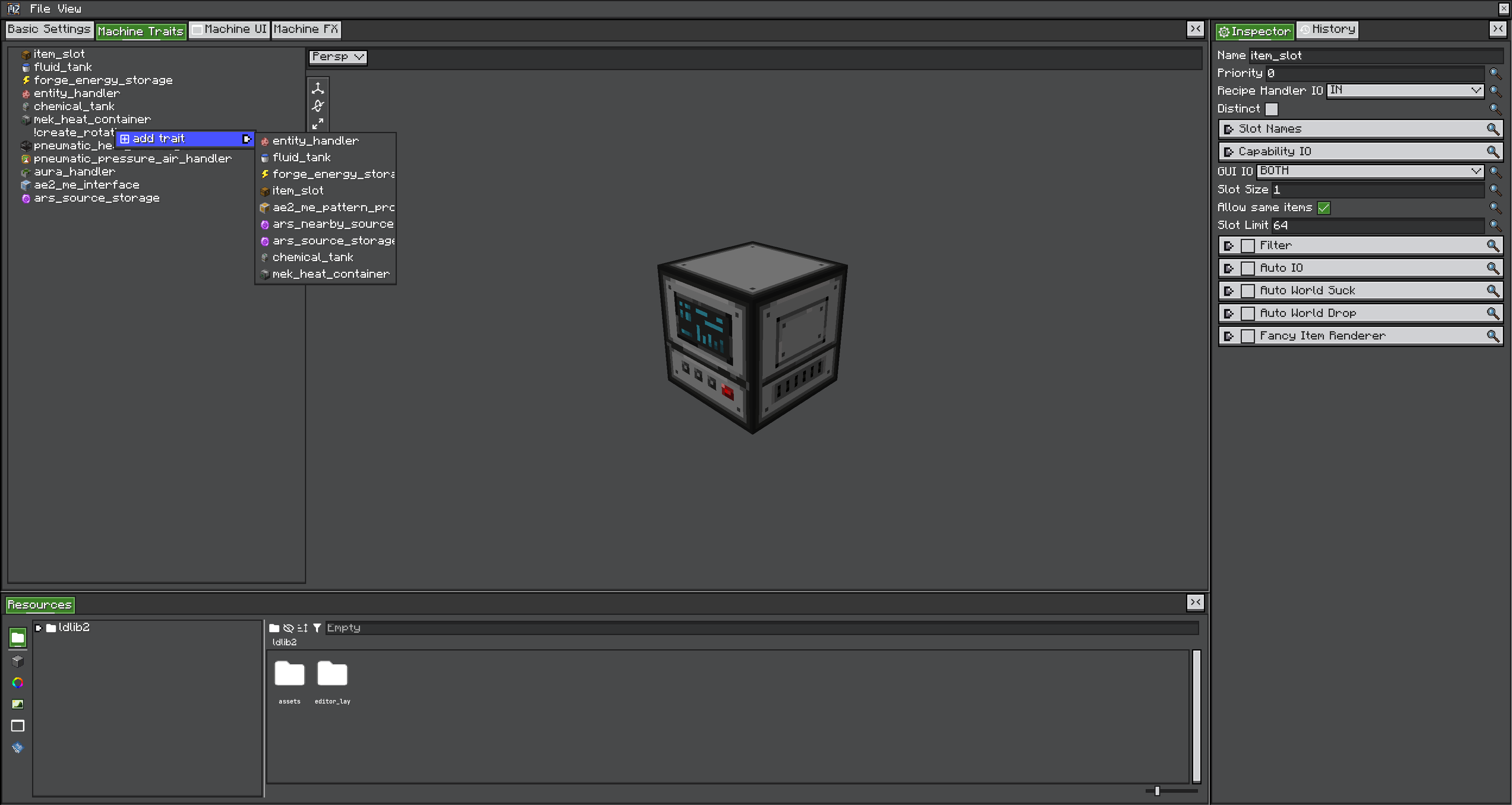
Choose an extension point
| Requirement | Implement | Registration |
|---|---|---|
| Load an editor-authored machine from your mod JAR | MBDRegistryEvent.Machine listener | NeoForge mod event bus |
| Add a new machine project/definition family | MachineDefinitionType<T> and definition subclass | @LDLRegister static field |
| Add storage, behavior, or a block capability | TraitDefinition + Trait | TraitDefinitionType static field |
| Add a recipe content domain | RecipeCapability<T> + IContentSerializer<T> | RecipeCapability static field |
| Let a trait consume/produce that content | IRecipeHandlerTrait<T> or RecipeHandlerTrait<T> | Returned by the runtime trait |
| Add an environmental/runtime prerequisite | RecipeCondition | Annotation on the condition class |
| Add a blueprint node | A KilaGraph Node subclass | @NodeAttribute(graphTypes = MachineBlueprintGraph.class) |
Start with Gradle dependency setup, then read registration and lifecycle. After the workspace resolves MBD2 and LDLib2, follow the complete custom capability, custom trait, and custom condition tutorials.
Before writing Java
Blueprints reach every machine event, every trait handler and the whole recipe object without a mod. Reach for Java when you need a new kind of thing — a storage model, a content type, a condition — not a new behaviour built from the existing ones.
API level
These pages describe MBD2 21.1.1. The registries are frozen after MBD2's construction work; do not register these objects from common setup, server start, or a KubeJS server script.