
Runtime Data Injection
Runtime property layer 2.2.0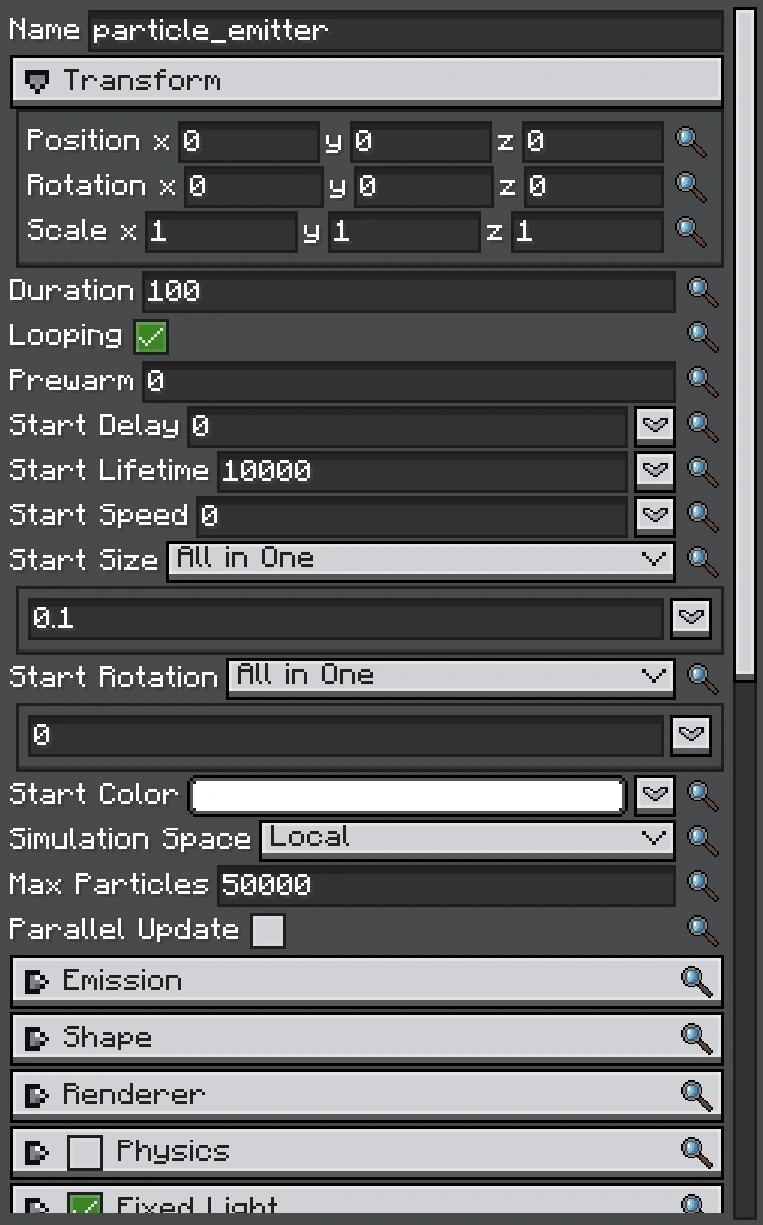
Runtime injection writes the instance-side slots represented by the Inspector and consumed by modules, renderers, Timeline, or Custom GPU Data.
Runtime injection changes one playback instance without mutating the authored .fx definition. Find the runtime object, check its concrete type, then write its RuntimeValue slots.
Complete Example
package com.example.client;

import com.lowdragmc.photon.client.fx.FXRuntime;
import com.lowdragmc.photon.client.gameobject.IFXObject;
import com.lowdragmc.photon.client.gameobject.emitter.data.RendererSetting;
import com.lowdragmc.photon.client.gameobject.emitter.data.number.Constant;
import com.lowdragmc.photon.client.gameobject.emitter.particle.ParticleEmitter;

public final class PhotonInjection {
    private PhotonInjection() {}

    public static void configure(FXRuntime runtime) {
        IFXObject object = runtime.findObject("sparks");
        if (!(object instanceof ParticleEmitter emitter)) {
            return;
        }

        var values = emitter.runtime();

        // Top-level ParticleConfig slots.
        values.startSpeed.set(new Constant(0.2f));
        values.maxParticles.set(256);

        // Module slots. Enabling and the value are separate overrides.
        values.physics.enable.set(true);
        values.physics.gravity.set(new Constant(0.03f));
        values.emission.emissionRate.set(new Constant(24f));

        // Per-emitter renderer override; identical effective values can still batch.
        values.renderer.layer.set(RendererSetting.Layer.Translucent);
        values.renderer.orderInLayer.set(20);
        values.renderer.writeCustomMask.set(true);
        values.renderer.maskGroup.set("wiki_target");

        // Additional GPU Custom Data: stream 0, X/R channel.
        values.customData.slot(0, 0).set(new Constant(0.85f));
    }

    public static void restoreAuthored(FXRuntime runtime) {
        if (runtime.findObject("sparks") instanceof ParticleEmitter emitter) {
            var values = emitter.runtime();
            values.startSpeed.clear();
            values.maxParticles.clear();
            values.physics.enable.clear();
            values.physics.gravity.clear();
            values.emission.emissionRate.clear();
            values.clearRenderOverride();
            values.customData.slot(0, 0).clear();
        }
    }
}
RuntimeValue Contract
| Method | Result |
|---|---|
get() | Effective value: override, otherwise authored fallback |
authored() | Authored config value even while overridden |
set(T) | Set a typed instance override |
setRaw(Object) | Untyped generic path used by Timeline; avoid in normal integration code |
clear() | Remove override and return to authored fallback |
isOverridden() | Whether a non-null override exists |
null means “no override”; do not use set(null) as data.
Runtime Types
ParticleEmitter, TrailEmitter, BeamEmitter, and AraTrailEmitter each expose runtime(). Their runtime layers contain top-level values, module runtimes, renderer overrides, and CustomDataRuntime appropriate to that emitter. Do not cast based only on an object name: names are author-controlled and may repeat; always use instanceof.
findObject(name) returns the first exact name match; findObjects(name) returns all matches. For a stable integration contract, give API-facing objects unique names and document them with the effect asset.
Timing and Ownership
Apply setup overrides after creating the runtime and before emit() when possible. For values that must follow gameplay, update on the client tick. Use per-frame updates only for interpolated transforms or render-time values.
Timeline Animation uses the same slots and writes them during evaluation. The last write for a sample wins. A Timeline track that writes every tick/frame will replace a one-time Java value; dedicate separate slots/Custom Data streams or establish one owner.
All runtime and renderer mutations are client-thread work. Do not mutate them from networking, async resource listing, or worker callbacks without scheduling onto the Minecraft client.