Core Shader Node Reference
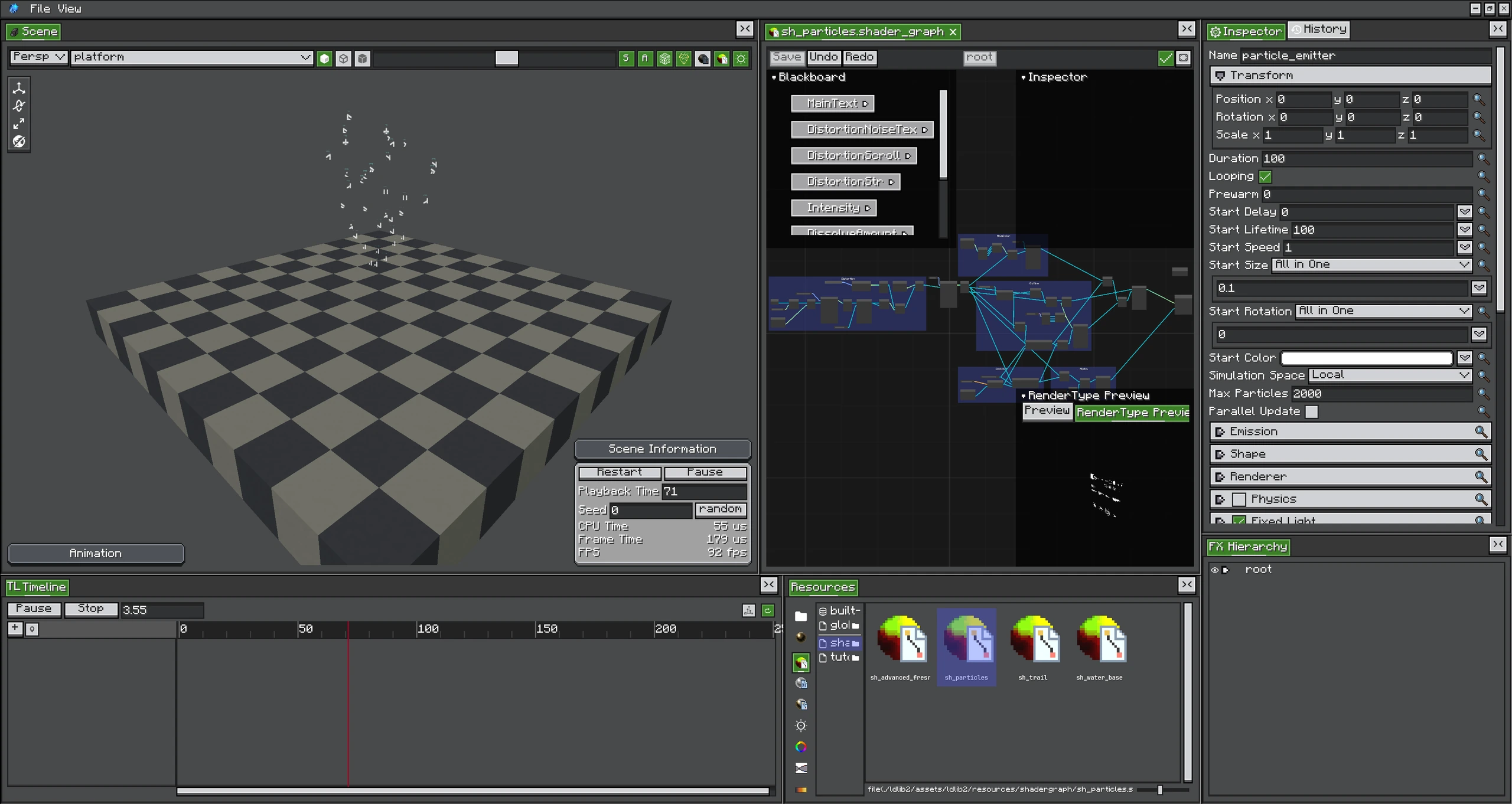
Node categories are building blocks; a practical graph usually combines texture sampling, channel math, masks, and output nodes.
Photon Shader Graph includes KilaGraph's general shader nodes. This page groups them by intent; node tooltips and the node description panel show exact ports and accepted types.
Numeric and Logic
| Group | Typical nodes | Use |
|---|---|---|
| Basic math | Add, Subtract, Multiply, Divide, Min, Max | Combine masks and values |
| Advanced math | Power, Exp, Log, Sqrt, Reciprocal | Falloff and response curves |
| Range | Clamp, Saturate, Remap, Smoothstep, Step | Normalize and shape transitions |
| Trigonometry | Sin, Cos, Tan, Atan2 | Waves, rotation, polar coordinates |
| Logic | Compare, Select, And, Or, Not | Branch-like masks without Java logic |
Use Saturate after arithmetic that feeds Alpha. Use Smoothstep(edge0, edge1, x) for a stable soft boundary; swapping the edges reverses the ramp.
Vector, Matrix, and Channels
- Compose/Split/Swizzle builds and extracts vector channels.
- Dot measures alignment; Cross produces a perpendicular vector.
- Length/Distance/Normalize handle direction and radial masks.
- Matrix Multiply/Transform changes coordinate spaces. Confirm whether a port expects a point or direction; translation must not affect directions.
UV and Procedural
UV nodes cover tiling/offset, rotate, polar/twirl, flipbook, and screen-space mapping. Procedural nodes generate noise, checker, ellipse, rectangle, gradients, and Voronoi-like masks. Procedural noise is recalculated per vertex/pixel; a texture is usually cheaper when the pattern does not need to change mathematically.
Texture and Artistic
Texture Sample reads a texture/sprite with UV and sampler state. Color-space conversion, blend, contrast, hue/saturation, and posterization nodes shape the sampled result. Keep masks in scalar channels instead of carrying vec4 values through every operation.
Normal, Fog, and Lighting
Normal nodes unpack and transform normal maps. Lighting nodes consume world normal, light, and view direction; fog nodes mix with Minecraft fog. Photon Particle Data.litColor already includes baked block/sky lighting, while raw color does not—do not multiply both paths unless that double-lighting is intentional.
Small Patterns
Dissolve: noise - threshold -> Smoothstep -> Alpha
Rim: 1 - Saturate(Dot(normal, viewDirection)) -> Power -> Emission
Flipbook: ParticleData.uv + frame/tiles -> Sample Texture
Soft particle: texture alpha × Depth Fade -> Alpha
For Photon-specific particle, scene, and full-screen inputs, continue with Photon Node Reference.