
Vertex Formats and GPU Instancing
GPU instancing 2.2.0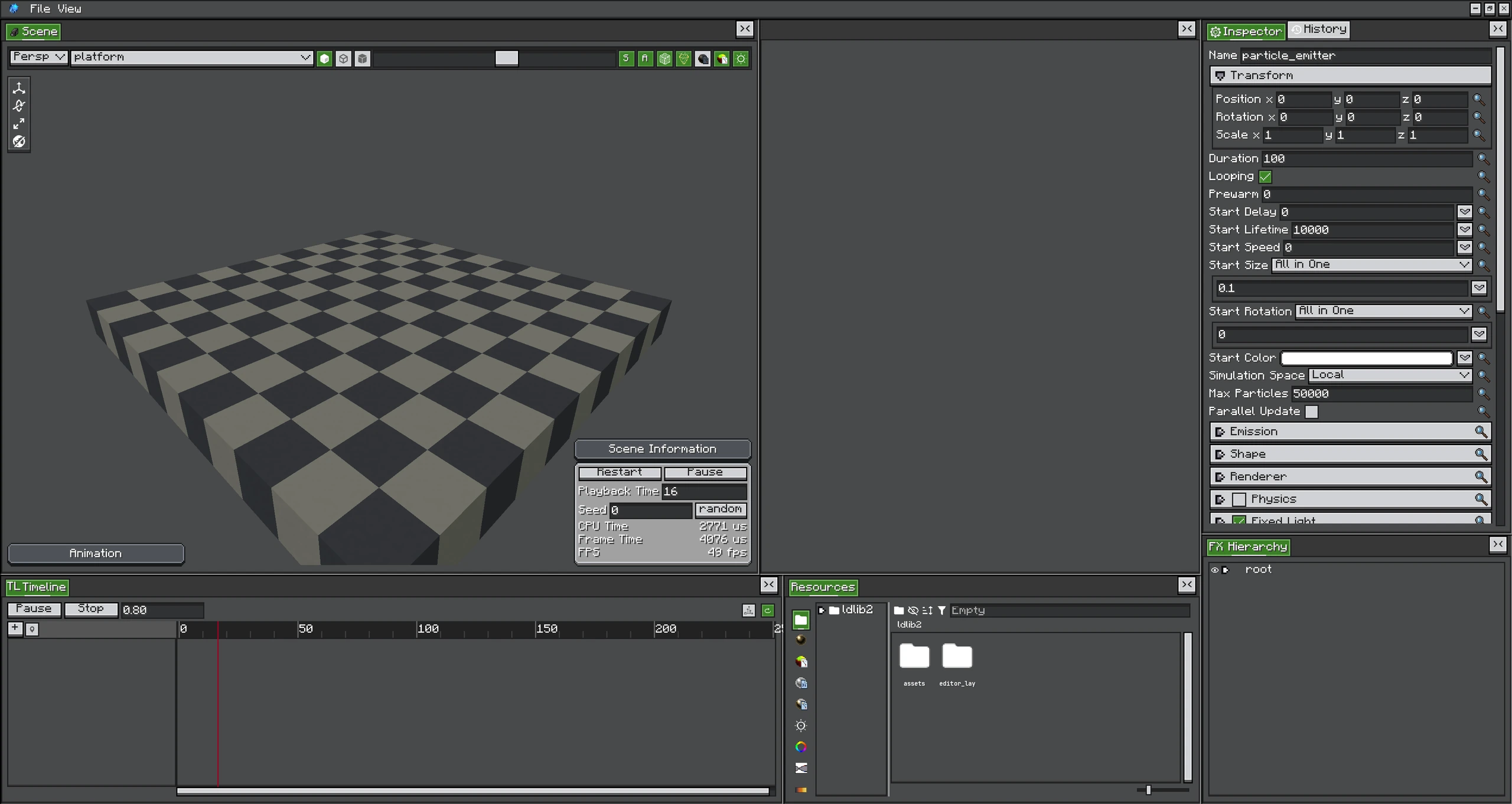
The instance project exercises the particle instance format while the full editor keeps Scene, Inspector, Resources, and Timeline visible.
Photon batches equal geometry/material state and draws many instances together. Base mesh vertices describe a quad, model, or trail segment; per-instance records supply transform, color, UV, light, and optional data.
Render Variants
| Define | Geometry | Base instance content |
|---|---|---|
PARTICLE_INSTANCE | billboard/tile quad | position, rotation, size, color, UV/light |
PARTICLE_MODEL_INSTANCE | model mesh | transform, color, UV/light with model attributes; optional tangent |
TRAIL_INSTANCE | flat/tube trail segment | endpoints, width/color/UV per point |
BEAM_INSTANCE | ray/beam segment | start/end, width/color/UV |
ARA_TRAIL_INSTANCE / ARA_TRAIL_TUBE_INSTANCE | flat / tube AraTrail segment | adjacent point data and interpolation |
Non-instanced CPU paths still expose Particle Data. Changed 2.2.8 Since 2.2.8, a non-instanced Particle Emitter also uploads per-particle Additional and Custom Data records when one of its materials reads them (a Shader Graph or Kila Material). Trails, beams and AraTrail still need GPU instancing for those streams; without it they read zero.
Extra Defines
Photon adds these defines on top of a render variant:
| Define | Added to | Version | Meaning |
|---|---|---|---|
PHOTON_TANGENT | PARTICLE_MODEL_INSTANCE | Since 2.2.5 | The Model render mode's tangent toggle is on. Adds layout(location = 3) in vec4 aTangent (xyz = tangent, w = handedness). |
PHOTON_VAT | PARTICLE_MODEL_INSTANCE | Since 2.2.7 | An animated glTF model plays per particle. The vertex shader reads the pose from a baked table (PhotonVat). |
PHOTON_CPU_DATA | the CPU path (no instance define) | Since 2.2.8 | A Particle Emitter draws without instancing and a material reads particle data. Records are found per particle, not by gl_InstanceID. |
getParticleData() handles all three. With PHOTON_TANGENT, the model's per-instance attributes stay at locations 4–8 and legacy Custom Data still starts at 9. The tangent toggle needs GPU instancing; glTF models keep their own tangents, and other models get tangents generated from their UVs.
ParticleData.Tangent and ObjectTangent carry the tangent frame. Instanced billboards, trails, beams and AraTrail build an exact tangent in the vertex shader, so they need no toggle. Model instancing without the toggle and the non-instanced CPU path report a constant vec4(1, 0, 0, 1). See glTF Models for animated models.
Two Data Layouts
The legacy attribute layout contains only inspector-enabled channels, in registry order. Turning a channel on can move later attribute locations. A hand-written shader and emitter configuration must therefore agree exactly.
Shader Graph uses a fixed vec4 slot layout per emitter kind, indexed by gl_InstanceID (per particle on the PHOTON_CPU_DATA path). The compiler records which channels are read and uploads the effective mask. One compiled graph can serve emitters with different inspector toggles.
Batching Limits
A draw batch breaks when geometry, material program, texture/sampler state, render layer, or required layout differs. Multi-material models require separate passes. Large custom data and many transparent layers also increase upload and sorting cost even when instance count is low.
Use the profiler and render statistics rather than assuming instancing is always faster. For a handful of particles, setup cost may dominate; for hundreds of identical quads/models, it normally wins.
Shader Author Checklist
- Shader Graph uses Photon accessors. The legacy Custom Shader Material path must declare attribute locations matching the emitter toggles.
- Read
PhotonDatathrough thephoton_data_*()accessors instead of indexing it yourself: instanced draws index it bygl_InstanceID, thePHOTON_CPU_DATApath per particle. - Treat unsupported channels as zero and provide a sensible fallback.
- Keep transparent sort/layer requirements consistent so emitters can batch.
- Test tile, model, trail, and beam separately; their base inputs are not interchangeable.
See Additional GPU Data for the Custom Data location formula and complete shader code.