
Subgraphs
A subgraph node represents another graph inside the current graph.
The subgraph node's ports are generated from the inner graph's exposed variables.
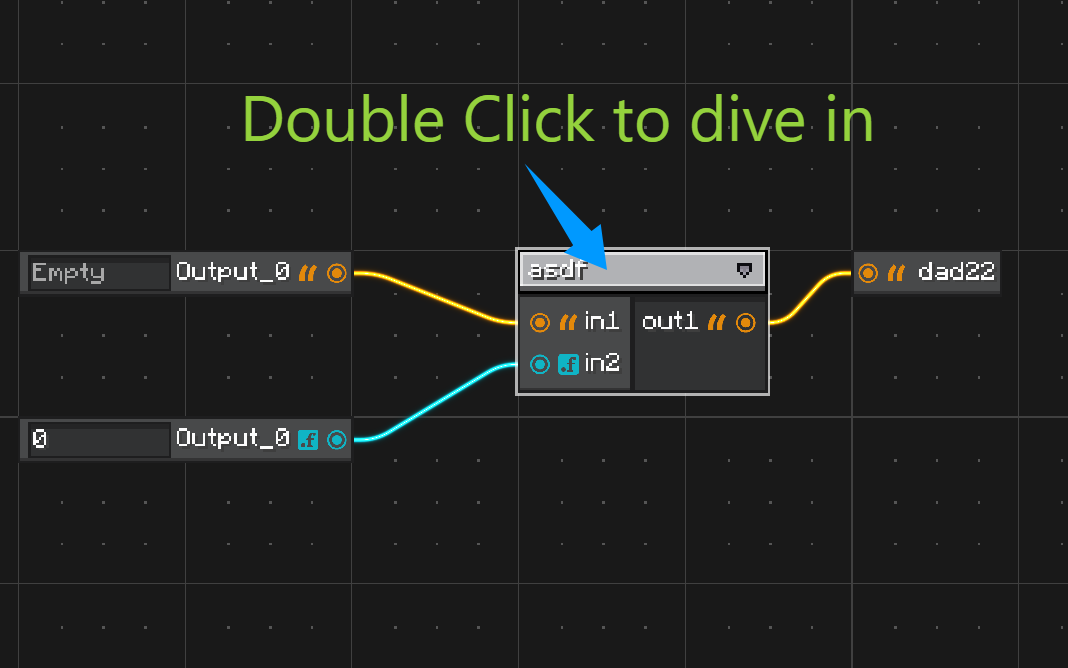
Use GraphEditorView when users need to enter subgraphs. The double-click action is handled by the subgraph node element and asks the nearest GraphEditorView to open the inner graph as a new breadcrumb level.
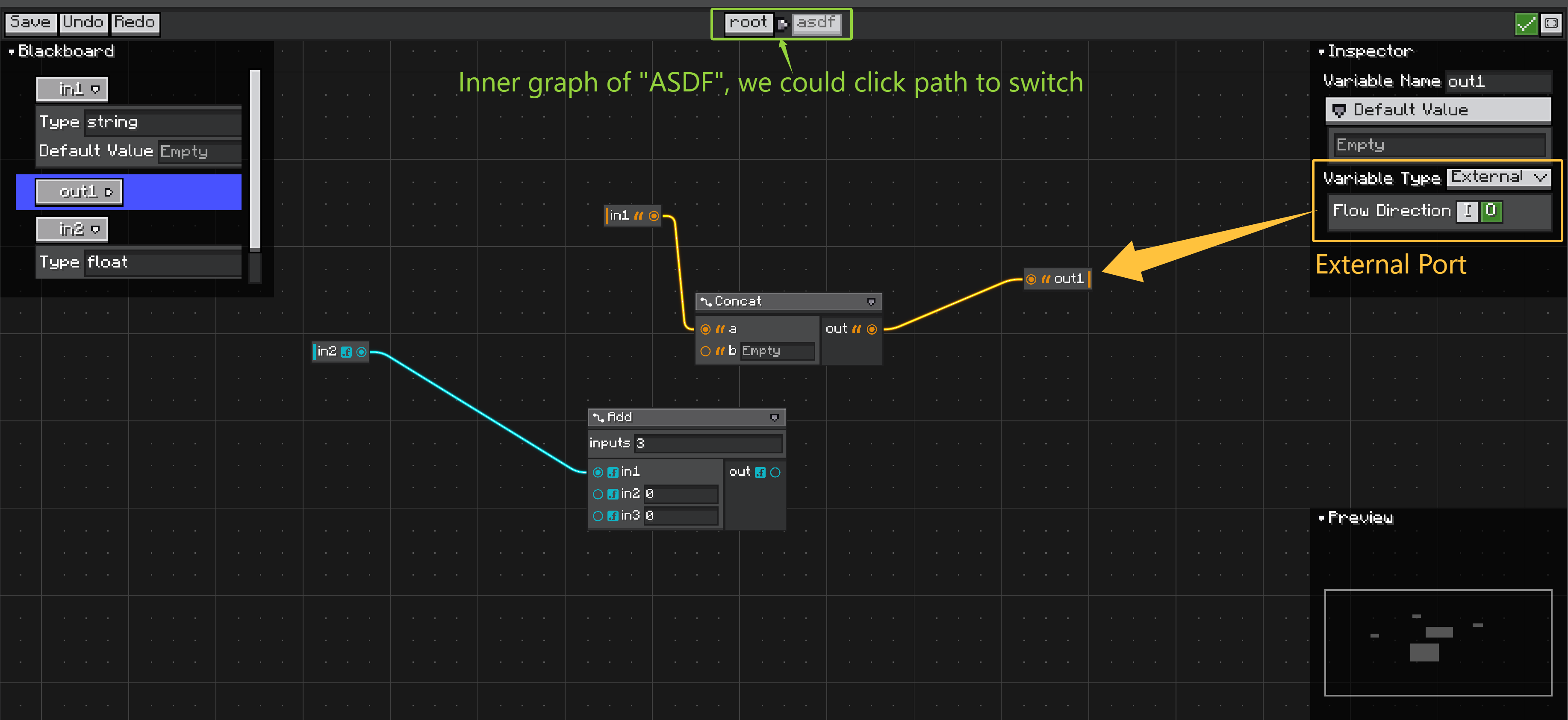
Inside the subgraph, ports are not edited directly on the subgraph node. Define variables in the blackboard, then set their flow direction in the inspector:
Inputcreates an input port on the parent-facing subgraph node.Outputcreates an output port on the parent-facing subgraph node.Input + Outputcreates both ports.
See Variables and Blackboard for the exact direction mapping.
Local Subgraphs
Local subgraphs are stored inline in the parent graph.
SubgraphNodeModel.Kind.LOCAL points to a graph in the parent model's localSubGraphs list by UID.
Use local subgraphs when the inner graph belongs only to the parent graph.
External Subgraphs
External subgraphs point to an IResourcePath.
SubgraphNodeModel.Kind.EXTERNAL resolves through GraphModel.getReferenceResolver().
Outside an editor context, the resolver can be null. In that case, the subgraph node reuses its cached port shape so existing wires can survive.
Import External Subgraphs from Resources
For resource-backed graph assets, drag a graph resource from the editor resource panel onto the graph canvas.
The editor flow is:
GraphResourceProviderContainer keeps the dragged resource path, so the dropped node stores a stable external reference instead of copying the graph NBT.
The drop is rejected when:
- the graph does not allow subgraph creation,
- the resource is dropped outside the graph content area,
- the resource is the same path as the opened root graph,
- the resource belongs to another graph type and the host graph does not accept it through
acceptsSubgraphGraph(...).
After import, the node behaves like any other subgraph node. Double-click it to edit the referenced graph. When editing an external subgraph through a dive-in view, GraphEditorView saves that level back through the reference resolver and SubgraphRegistry refreshes other open graphs that reference the same resource.
Variable Ports
Subgraph node ports are generated from the inner graph's variables:
| Inner variable | Outer subgraph node |
|---|---|
VariableKind.INPUT | Input port. |
VariableKind.OUTPUT | Output port. |
READ_WRITE variables create both directions with suffixed port ids.
Use this graph hook to limit exposed variable directions:
@Override
public Set<VariableKind> getSupportedSubgraphVariableKinds() {
    return Set.of(VariableKind.INPUT, VariableKind.OUTPUT);
}
Return an empty set to disable variable-backed subgraph ports.
Cross-Type Subgraphs
Same-type local subgraphs are allowed by default.
For cross-type subgraphs, the host graph must opt in:
@Override
public boolean acceptsSubgraphGraph(Graph other) {
    return other instanceof MaterialGraph;
}
This applies to imported external references and foreign local subgraphs.
External Save Broadcasts
SubgraphRegistry broadcasts when an external graph resource is saved.
Subscribers are:
- root
GraphModelinstances that need to redefine subgraph node ports, - editor listeners that may reload or refresh open graph views.
GraphEditorView registers while a graph is loaded and unregisters when cleared.